

Categories
22 Jul, 2026
Savvy Tips
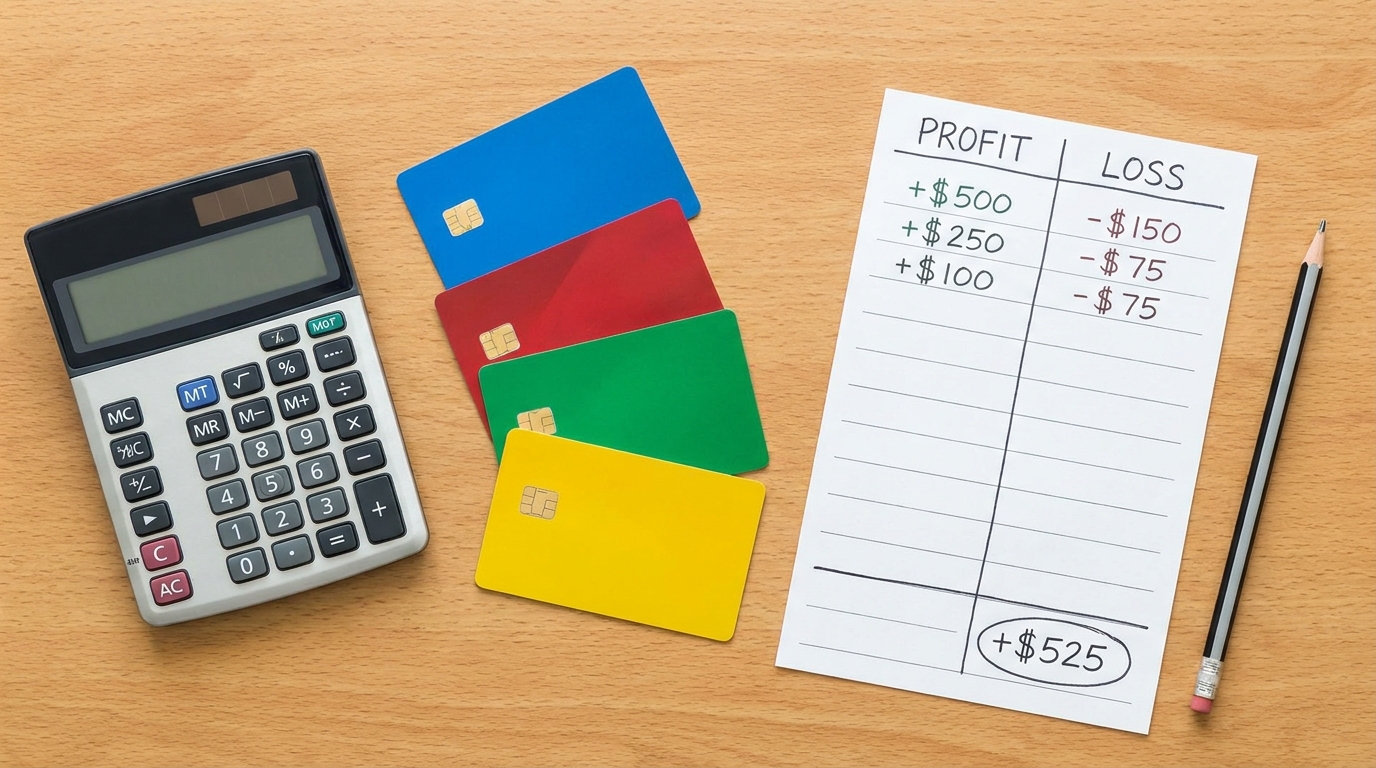
Credit card rewards programs distribute approximately $35 billion annually to US cardholders in the form of cash back, miles, and points. The average rewards cardholder earns an estimated $168 in annual rewards. This sounds straightforwardly good, until you account for what the behavioral finance research says about what rewards cards cost the people who use them, and what percentage of earned rewards are ever actually redeemed.
$35B
distributed annually to US cardholders in rewards
$168
average annual rewards earned per cardholder
27%
of earned rewards that go unredeemed
10-30%
typical behavioral overspend increase with rewards cards
What you actually earn versus what you think you earn
The headline rewards rate on any card, 2%, 3%, or 5%, applies only to the spending that lands in the stated categories, at the stated merchants, up to any applicable caps. The effective rewards rate across a cardholder's total annual spending is almost always lower than the headline rate. A card advertising 5% on groceries and 1% everywhere else, for a household spending $800 per month on groceries and $2,000 per month on everything else, earns $576 on groceries and $240 on other spending. The blended rate is 2.8% on total spend, not 5%. This is not deceptive, but it does mean you need to look at total annual rewards earned relative to total card spending to understand your real rate.
Annual fees further reduce net rewards. A $95 annual fee card that earns $480 in rewards delivers $385 in net value. A no-fee card earning 2% on the same spending delivers $480. The fee card outperforms only when the rewards rate advantage exceeds the fee divided by total spending. For most cardholders running $3,000 per month in spending, the crossover where a $95 fee card becomes superior is approximately 2.1% effective rate or better, a threshold that requires actively using the card in its bonus categories.
The behavioral overspend problem
Multiple peer-reviewed studies in behavioral economics have documented that people spend more when using credit cards than when using cash. Research from MIT and Carnegie Mellon found that credit card users paid up to 83% more for the same goods in experimental bidding settings. Real-world studies using transaction data consistently find 10 to 30% higher average transaction sizes when paying with a rewards card versus a debit card or cash.
For a household running $3,000 per month in card spending, even a modest behavioral spend increase of 10%, or $300 per month, adds $3,600 to annual spending. At a 2% rewards rate, the additional rewards earned from that additional spending is $72. The net effect of the behavioral increase is a loss of more than $3,500 in actual money for $72 in rewards. The rewards did not save money. They provided a psychologically satisfying reason to spend more than was necessary.
This does not apply uniformly. Cardholders who primarily use cards for planned, recurring expenses, subscriptions, groceries, utilities, and gasoline, with limited use for discretionary purchases, do not show the same behavioral overspend patterns. The research suggests that rewards cards damage financial outcomes most for cardholders who use them extensively for discretionary, in-the-moment purchases.
Rewards Net Value Calculator
Calculate your true net annual benefit from a rewards card after fees and any behavioral overspend.
The redemption gap
Approximately 27% of credit card rewards earned in the United States go unredeemed. For airline miles and hotel points with expiration provisions, the figure is higher. Unredeemed rewards represent pure transfer of value from cardholders to issuers. The psychological dynamic is straightforward: once points are accumulated, many cardholders either cannot identify a redemption that satisfies them, prefer to hold for a hypothetical future use, or simply forget to check their balances until expiration.
The products with the worst redemption rates are co-branded airline cards. Miles accumulated on a carrier you no longer fly regularly sit dormant, expire, and return nothing. The welcome bonus that looked attractive at account opening never converts to a flight because the cardholder's travel patterns changed. If you are accumulating points in a program and have not redeemed anything in 18 months, the program is not working for you.
Who actually comes out ahead
Cardholders who come out clearly ahead with rewards programs share several characteristics. They pay their full balance every month, which eliminates interest as a factor. They use the card primarily for planned, predictable expenses rather than discretionary spending. They actively track their rewards balances and have a specific redemption target in mind. They review their card annually and close or downgrade products where fees exceed earned rewards. And they use redemption methods that capture the full value of accumulated rewards rather than leaving a percentage on the table through portal-only redemptions.
For cardholders who carry balances, use cards for discretionary spending, rarely check reward balances, or cannot readily explain the redemption value of their current points, the rewards program is almost certainly costing them more than it returns.
Frequently asked questions
Is a cash back card better than a travel rewards card for most people?
For most people, yes. A 2% flat cash back card delivers transparent, liquid value with no expiration, no partner complexity, and no risk of devaluation. Travel rewards can exceed cash back value for cardholders who plan specific redemptions and have the flexibility to use transfer partners. But for the majority of cardholders who redeem through portals or cash out points, the effective value difference between a flat cash back card and a travel rewards card is smaller than marketing materials suggest, and the simplicity of cash back produces better actual outcomes.
Should I use rewards cards for all spending or just specific categories?
The behavioral research suggests that using rewards cards selectively, for predictable, planned expenses rather than discretionary purchases, produces better financial outcomes. Setting specific card rules and routing impulse or discretionary purchases through cash or debit breaks the psychological link between spending and reward accumulation that drives overspend. Category-specific routing also maximizes rewards rates: using the right card for each category earns more than a single flat-rate card, but only if the routing rules are maintained consistently.
Do annual fee cards deliver better rewards than no-fee cards?
Sometimes, but the margin is smaller than issuers imply. A $95 annual fee card needs to earn at least $95 more per year than the best no-fee alternative in your actual spending categories before the fee is justified. For many cardholders spending in categories where no-fee 2% cards are competitive, the extra rewards from a fee card do not cover the fee. Run the calculation on your actual spending mix, not on the card's advertised features, to determine whether the fee card creates or destroys value for your specific pattern.
